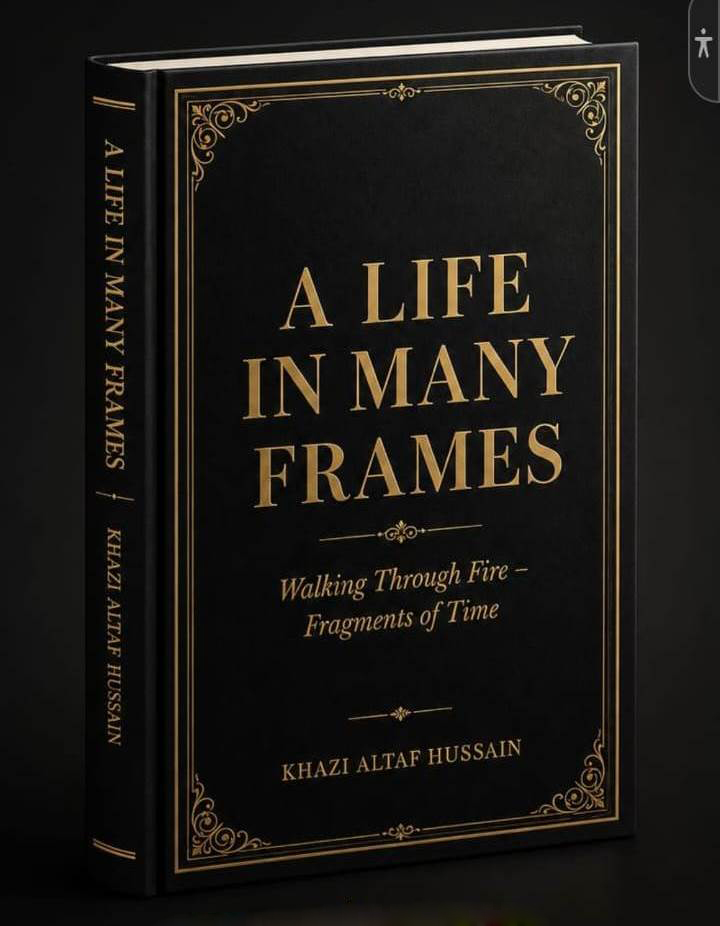
Hyderabad, July 01, 2026: There are autobiographies that merely narrate the life of an individual, and there are memoirs that quietly become the story of an era. A Life in Many Frames – Walking Through Fire: Fragments of Time belongs to the latter category. It is not simply the recollection of one man’s experiences; it is a thoughtful chronicle of post-Independence India viewed through the eyes of a corporate professional, institution builder, social worker, media entrepreneur, and community leader whose life intersected with many of the country’s significant social, industrial, and humanitarian developments.
The book stands apart because it does not attempt to glorify achievements or construct a larger-than-life personality. Instead, it presents a collection of lived experiences—each frame capturing a different phase of life, each chapter revealing a different responsibility, and each challenge demonstrating that leadership is ultimately measured by service rather than position.
The title itself is profoundly symbolic. Just as a photograph captures a single moment while hinting at a much larger story, every chapter in this book represents one important frame in a life shaped by commitment, resilience, and continuous learning. Together, these individual frames create a compelling portrait of a generation that witnessed India’s transformation from a developing nation into one of the world’s fastest-growing economies.
The author’s journey mirrors the aspirations of post-Independence India. Beginning with modest roots, his professional life unfolds alongside the growth of modern Indian industry, management education, infrastructure development, healthcare expansion, and the cooperative movement. His experiences demonstrate how opportunities created in independent India enabled countless professionals to contribute meaningfully to nation-building beyond the confines of government service.
One of the book’s greatest strengths lies in its authenticity. The narrative is refreshingly free from unnecessary embellishment. Successes are recorded with humility, setbacks are narrated with honesty, and difficult periods are described with remarkable emotional balance. The reader is invited not into the life of a celebrated personality but into the mind of an individual who believed that every responsibility deserved complete commitment.
The corporate chapters deserve special mention. They provide valuable insights into an era when Indian industry was undergoing rapid professionalisation. The author takes readers beyond boardrooms and organisational structures to reveal the human side of management. Whether dealing with large infrastructure projects, human resource development, industrial relations, crisis management, or organisational transformation, he consistently demonstrates that people remain the most valuable asset of any institution.
 Particularly noteworthy are the accounts of power generation projects, healthcare initiatives, the dairy sector, pharmaceutical management, and institutional development. These chapters become more than professional memoirs; they serve as case studies in leadership, decision-making, teamwork, and ethical administration. Young managers, management students, and aspiring entrepreneurs will find practical lessons woven naturally into the narrative without the tone ever becoming instructional.
The humanitarian dimension of the book is equally powerful. The author’s recollections of responding to natural disasters, communal disturbances, and public emergencies remind readers that true leadership often emerges during moments of crisis. These episodes are narrated not to highlight personal courage but to underline the importance of collective responsibility, compassion, and timely action.
Another distinguishing feature of the book is its remarkable diversity. Very few autobiographies successfully integrate corporate management, public administration, community service, healthcare, education, journalism, social leadership, and spiritual reflection within a single narrative. Here, each sphere enriches the other. Professional discipline strengthens social commitment, while community engagement gives greater meaning to corporate success.
The book also serves as a tribute to institutions. Throughout its pages, the author acknowledges mentors, colleagues, workers, professionals, and ordinary citizens whose contributions shaped his own journey. In an age that often celebrates individual accomplishment, this recognition of teamwork is both refreshing and deeply inspiring.
The language deserves appreciation for its simplicity and sincerity. The prose remains accessible without sacrificing depth. Readers from diverse educational backgrounds can relate to the experiences, while professionals will appreciate the practical wisdom that emerges naturally from real-life situations. There is no attempt to impress through complicated language; instead, clarity becomes the book’s greatest literary strength.
Perhaps the most significant contribution of A Life in Many Frames is that it preserves an important slice of contemporary Indian history through personal experience. Historians document events, governments preserve records, and institutions maintain archives, but autobiographies preserve something equally valuable—the human experience behind historical change. Through the author’s eyes, readers witness the evolution of corporate India, the growth of modern management practices, the expansion of healthcare services, the strengthening of dairy cooperatives, and the emergence of media platforms dedicated to specialised industries.
The book repeatedly reminds us that the progress of a nation is built not only by famous political leaders or industrial giants but also by thousands of dedicated professionals who quietly discharge their responsibilities with integrity, competence, and perseverance. Their stories seldom reach history books, yet they collectively shape the character and progress of a nation.
Equally moving are the reflective chapters dealing with family, personal loss, faith, ageing, and resilience. These quieter moments provide emotional depth to the narrative and remind readers that professional success never exists in isolation from personal life. Every achievement carries unseen sacrifices, and every milestone is supported by family, friendships, and enduring values.
The visual presentation of the book deserves mention as well. Carefully selected photographs and artistic chapter-opening illustrations complement the narrative beautifully, transforming the reading experience into a journey through memory. They reinforce the central metaphor of “many frames,” allowing readers to connect emotionally with each stage of the author’s remarkable life.
Ultimately, A Life in Many Frames – Walking Through Fire: Fragments of Time is more than an autobiography. It is a reflection on leadership, responsibility, perseverance, humility, and service. It demonstrates how an ordinary individual, guided by extraordinary commitment, can leave a lasting impact across multiple fields without ever seeking personal acclaim.
For readers interested in modern Indian history, corporate leadership, public service, social development, or simply the inspiring story of a life lived with purpose, this book offers both knowledge and inspiration. It reminds us that every generation has its storytellers, and every life, when lived with integrity and compassion, becomes a meaningful chapter in the larger story of the nation.
In preserving his own journey, the author has also preserved the journey of a changing India. That is perhaps the book’s greatest achievement—and the reason why A Life in Many Frames deserves a place not only on personal bookshelves but also in libraries, educational institutions, and among readers who value lives that inspire through action rather than words.
– Editorial Team